Are Salon Tools Disinfected? What to Expect
A beautiful fresh set should come with peace of mind. If you have ever watched a technician reach for a file, nipper, or metal pusher and wondered, “Are salon tools disinfected?” you are asking exactly the right question. Cleanliness is not an extra at a quality salon. It is part of the service, right alongside precise shaping, lasting color, and that relaxed, cared-for feeling.
The short answer is that reusable salon tools should be cleaned and disinfected between clients according to state board requirements and the product instructions for the disinfectant used. But the details matter. Not every item can be disinfected, and a tool that merely looks clean is not necessarily ready for another service.
Are Salon Tools Disinfected Between Every Client?
At a professionally operated nail salon, reusable tools that come into contact with nails or skin should be properly cleaned first, then disinfected between clients. Cleaning removes visible dust, product residue, and debris. Disinfection uses an approved solution to reduce harmful germs on nonporous tools and surfaces. These are separate steps, and both are necessary.
For clients, the most reassuring sign is a technician who follows a consistent process without making it feel clinical or rushed. Tools are cleared from the station after a service, placed aside for cleaning, and replaced with a fresh, prepared set for the next guest. Your appointment should feel polished from the first color swatch to the final cuticle oil, not like sanitation is being handled as an afterthought.
There is one key distinction: disinfection is not the same as sterilization. Sterilization is a more intensive process typically associated with medical settings. Nail salons use approved disinfection procedures designed for salon tools and services. The goal is appropriate, state-compliant hygiene for the environment – not a hospital operating room.
What Should Be Disinfected at a Nail Salon?
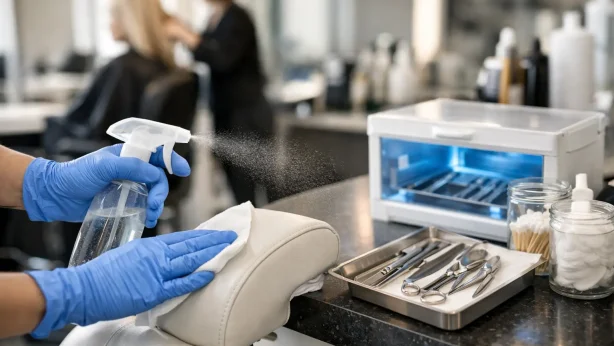
Metal, nonporous tools are generally designed to be cleaned and disinfected between clients. This can include cuticle pushers, nippers, nail clippers, metal files, and certain drill bits. The exact process depends on the tool and the disinfectant manufacturer’s directions, including the required contact time.
High-touch work surfaces need attention, too. A technician’s table, armrest, lamp, and other surfaces used during a manicure should be cleaned and disinfected between guests. During a pedicure, the chair and footbath require their own detailed sanitation routine. The basin, jets or removable components, and surrounding touchpoints should be cleaned and disinfected according to applicable requirements.
Items that cannot be fully disinfected should be single-use. Think disposable buffers, wooden cuticle sticks, toe separators, sanding bands, and many files. Once these porous items have been used, they should be discarded or, where appropriate, given to the client for personal use. Reusing a disposable file because it still “looks fine” is not the standard you should have to accept.
What Clean Salon Practices Look Like in Real Life
Sanitation does not need to be dramatic to be visible. In fact, the best habits tend to look calm, organized, and routine. Your technician may wash or sanitize their hands before beginning, set out clean tools, use fresh disposable supplies, and wipe down the service area after your appointment.
You may also notice tools being stored in a clean, covered container after disinfection. That matters because properly disinfected tools can be compromised if they are tossed loose into a drawer, mixed with used implements, or handled repeatedly before service begins.
Pedicure sanitation deserves extra attention because footbaths involve water, skin, and shared equipment. A clean-looking bowl alone is not enough. A thorough process addresses the basin and its components between clients, not simply a quick rinse. If a pedicure chair has removable parts, a quality salon should follow the appropriate cleaning and disinfection protocol for those pieces as well.
At Elodie Nail Lounge, sanitation is part of the elevated experience. A grade-A standard supports the details clients notice most: a comfortable setting, technicians who take their time, and the confidence to settle in for a detailed pedicure, a soft-glam Gel-X set, or a fresh everyday manicure.
Questions You Can Ask Without Feeling Awkward
You never need to apologize for asking about cleanliness. A good salon should be comfortable explaining its process, because hygiene is a professional responsibility, not a secret behind-the-scenes detail.
Try a direct, simple question: “Are these tools disinfected between each client?” If you are booking a pedicure, ask how the footbath is cleaned between services. If you have a cut, irritated skin, a nail infection, or another concern, mention it before the service begins. A responsible technician may need to adjust or postpone a service to protect you, themselves, and other clients.
Pay attention to how the question is answered. A clear, respectful explanation is reassuring. A vague response, visible clutter, or a technician reaching into a pile of used-looking tools is a reason to pause. Luxury is not only about the color wall, the lighting, or the finishing touch of lotion. It is about being cared for thoughtfully at every step.
Clean Does Not Mean Harsh or Uncomfortable
Some clients worry that strong sanitation standards will make a service feel cold or overly chemical. Done well, the opposite is true. A clean, orderly station lets you relax. You can enjoy choosing a rich fall shade, planning bridal nails, or taking a quiet break from a packed week without wondering what happened before you sat down.
There are also practical trade-offs. More thorough sanitation takes time, and a salon that protects time between appointments may not be able to turn every chair immediately. That is not poor service. It can be a sign that the team is making room for proper reset procedures rather than rushing guests through.
Likewise, a technician may choose disposable tools for certain steps even when reusable options exist. This can create more supply cost, but it supports a cleaner service model. The value is in the standard, not just the finished photo.
When You Should Reschedule a Nail Appointment
Salon disinfection reduces risk, but it cannot make every appointment appropriate. Consider rescheduling if you have open cuts around the nails, active redness or swelling, unexplained discoloration, a suspected fungal infection, or a contagious skin condition. Nail enhancements can look fierce, but healthy natural nails and skin always come first.
A trained technician should never attempt to diagnose a medical condition. If something seems unusual or painful, seek guidance from a qualified healthcare professional before returning for a manicure, pedicure, acrylic removal, or extension service. This protects your results in the long run and gives your nails the time they need to recover.
The right salon experience feels beautiful because it is built on care. Look for technicians who use fresh supplies, maintain a clean station, respect your questions, and never rush past a concern. Then you can choose your color, enjoy the moment, and leave with fresh fingertips that feel as good as they look.